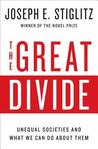
 The Great Divide: Unequal Societies and What We Can Do About Them by Joseph E. Stiglitz
My rating: 4 of 5 stars
The book is a composite of essays and articles written by economist Joseph Stiglitz over the past several years. As the subtitle implies, the theme of these articles address the increasing inequalities of both U.S. and global economies, and in particularly how the recession beginning in 2007-2008 exacerbated those inequalities. The collection of essays is both a strength and weakness of the book. It makes it easy to read due to easily being able to pick up and read short chunks via the articles. Yet, it also makes the book somewhat redundant at times, as you begin to pick up on arguments Stiglitz's makes in different articles.
Outside of those particular concerns over the structure of the book, the content is thought-provoking, and truly anger-inducing at times. The anger is political as well as economic, and while much of the anger can be directed at just the Republican Party and conservatives, it is more appropriately directed at all in power, Republicans and Democrats alike, who allow moneyed interests to control policy, to the detriment of most Americans. In particularly, for me, I like the repeated discussion by Stiglitz of the economic concept of consumption, and what it means for economic recovery, and how it works very much to the contrary of the "trickle down economics" theory sometimes still pushed by various politicians. It demonstrates very clearly why the recovery from the recession has been so sluggish, as all the new income and growth has gone to the top of the economic ladder, not the middle or bottom. As such, there is very little actual new spending to stimulate the economy.
Stiglitz also presents cogent thoughts on why regulation is important, particularly in light of the deregulation of the financial services industry and the role said industry played in the recent recession. In so doing, he rejects, in part, the arguments from another economist with a big book out recently (Thomas Piketty's "Capital in the 21st Century). Piketty argued that capitalism necessarily resulted in inequality, and that the period post WWII where everyone in the economic spectrum benefitted was the exception, not the rule, to capitalism. Sitglitz, at least how I read him, rejects this argument, primarily because he does not see the modern economy as true capitalism. He maintains that a true capitalism, a true market, is created and regulated by government, not left to its own devices. In a sense, this isn't necessarily a rejection of Piketty, but a similar recognition of significant problems, and finding a different solution (appropriate regulation of markets and better tax code applied to actual income versus Piketty's global wealth tax).
In any event, having read both Piketty and now these articles by Stiglitz, I have a much better understanding of economics than I did previously. Also, having previously read Piketty, I understood some of the references in this book much better. Ultimately, this book successfully (I think) argues that the growing inequality in the U.S. and in the World is problematic, and unsustainable, and that the only way change can come about to address it is through better politics and better policies. Whether that is possible in the current political climate obviously remains to be seen, but its something I think more and more of us need to start paying attention to, and demanding that our elected representatives also pay attention to.
View all my reviews


No comments:
Post a Comment