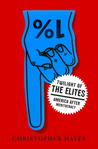
 Twilight of the Elites: America After Meritocracy by Christopher L. Hayes
My rating: 5 of 5 stars
I had this book on my to-read list almost since it came out, close to 4 years ago. Even though it took my that long to finally purchase a copy of the book and read it, my anticipation and excitement to read it remained high. The book did not disappoint.
In the book, Chris Hayes (the MSNBC host) analyzes the impact of what he considers the "fail decade," referring to 2000 to 2010. He discusses various "failures" that led to the increasing distrust of society's institutions - from the MLB steroid controversy to the Catholic Church priest-child abuse scandal and coverup, to the decision-making process involved in the leadup to the Iraq War and the failure to recognize to the subprime mortgage crisis and the subsequent financial fallout/collapse. All this, Hayes argues persuasively, leads to what he terms a "crisis of authority." Americans, he says, have simply lost faith in its institutions.
This is made particularly acute in Chapter 4, titled "Who Knows." Hayes discusses three concepts of knowing - we know because we trust "consensus," because we value "proximity" (those close to the source), and because we generally give the benefit of good faith. He then uses all the examples from the Fail Decade to demonstrate how it has shaken the foundations of all those sources of knowledge - the Catholic Church scandal diminished the concept of benefit of good faith; the failure of business journalists and insiders (those with proximity) to see the forthcoming financial crisis did away with trust in that source; and the general consensus that existed on the Iraq War, and its subsequent revelation of being based upon falsified information and ultimately turned into a foreign policy disaster for the U.S., ruined the concept of consensus. Couple the breakdown of these sources with the boom of the Internet and the exponential proliferation of random sources, it becomes, as Hayes notes, overwhelming for the contemporary consumer of information - "the possibility of access to information that we can't possibly process induces a constant thrum of anxiety among conscientious citizens, one for which there is no obvious remedy." (125)
Another theme in Hayes' work, as indicated by the title, is meritocracy. Until reading this book, I don't think I realized how ingrained the concept of meritocracy (the cream will rise; the best of us should be in charge; etc.) is in our societal thinking. But as Hayes does a convincing job of arguing, the meritocracy of the 1960s on ". . . offered liberation from the unjust hierarchies of race, gender, and sexual orientation, but swapped in their place a new hierarchy based on the notion that people are deeply unequal in ability and drive." (21) Further, Hayes suggests that meritocracy results in the paradox of producing equality, but without mobility - "Indeed, over time, a society will grow both more unequal and less mobile as those who ascend its heights create means of preserving and defending their privilege and find ways to pass it on across generations." (59). This seems particularly explicative (and predictive) of American society, and Hayes does a good job of painting a bleak picture as a result of how persistent the faith in meritocracy is despite facts to the contrary. People continue to believe they can rise to the top if they work hard regardless of socioeconomic background, even though loads of evidence from the past 40 years says otherwise.
This leads to another theme discussed in the book - the difference and distinction between equality of opportunity and equality of outcome. Without much debate, one would be able to say confidently that most everyone agrees with equality of opportunity, but not so with equality of outcome (that's socialist! or communist!). Hayes doesn't necessarily argue for equality of outcome, but he does contend that society needs to pay more attention to it. Failing to do so means we fail to see the connection that outcome has to future equality of opportunity. Considering that the pushing of the meritocratic ideal has resulted in gross levels of economic inequality not seen since right before the Great Depression, despite better equality of opportunity than has existed in the past, there's seems to be some merit (no pun intended) to Hayes' contention.
When I finished the book, two things struck me right away. First, the book was very prescient about what has happened in the last 4 years to the economics and politics of the U.S., whereas any reasonable reader will quickly see the seeds of discontent for the anti-establishment movement that has dominated the 2016 election cycle thus far, along with the increased partisanship of our nation's political parties. Second, the bleak picture the books provides of any realistic ability to counteract this emerging reality. Simply put, when the governing class is the same as the elite economic 1% class, there is little realistic hope of systemic change in society.
Whether that truly is the case, time will show, I suppose. In any case, the book was well worth the read - it was always interesting, provided a good flow and was easy to read chunks at a time, and provided tons of thought-provoking material relevant for today's society; exactly what you want in a book of this type.
View all my reviews


No comments:
Post a Comment