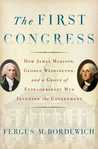
 The First Congress: How James Madison, George Washington, and a Group of Extraordinary Men Invented the Government by Fergus M. Bordewich
My rating: 4 of 5 stars
As the book says, it gives the history of the first Congress of the United States, meeting following ratification of the U.S. Constitution beginning in 1789. The men involved, to the well known players both in and out of Congress - James Madison (House), George Washington (President), Alexander Hamilton (eventual Cabinet), William Maclay (Senate), among many, many others - are discussed in great detail by Bordewich, using primary source documents effectively to tell the story without commentary, but often in the very words of those involved.
Its impossible to read this book in the United States less than 60 days before an election and not see the great differences. Its not that the men then were inherently better men (see: slavery), or less immune to various pressures (regional differences were arguably greater at this time than during any other period of U.S. history, and certainly more so than now), but they seemed to at least recognize the role and purpose of government. Their object in becoming a part of the government was, in whatever way they thought best, to govern. Certainly, some anti-federalists were extreme in wishing for the forsaken Articles of Confederation; but most everyone involved understood the necessity of the federal government, and worked to create a delicate balance between the various branches and between the states and national governments.
For me, I also note how important this would be to read for people interested in judicial interpretation of the Constitution. Not in the sense of stating that one particular school of interpretation is supported by this book; rather, the fact that it makes sense that reasonable people today differ in their interpretations, because the reasonable people who wrote the document disagreed about its meaning. In particular, as it comes to the famous "Bill of Rights," the first Ten Amendments to the Constitution, its worth noting how individuals then viewed the importance of certain things (the militia aspect being more important in the Second Amendment, as militias were the protection from the federal government), the wrangling over the inclusion or exclusion of one or two words in other amendments (such as the Tenth Amendment in particular), and how the order was determined (not necessarily in order of priority).
In sum, the book shows that attributing universality to the founding ideals of the United States is difficult, because it shows, similar to the writing, adoption, and ratification of the Constitution itself, most everything was achieved through a tough process of compromise with an eye towards the purposes government could serve. If nothing else, the book shows the importance of honest dialogue in coming up with good ideas. We would all be better off if we could remember that in today's world, and apply it to our politics.
View all my reviews


No comments:
Post a Comment