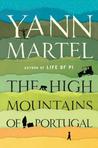
 The High Mountains of Portugal by Yann Martel
My rating: 3 of 5 stars
Having been a big fan of Martel's "Life of Pi" that I read several years ago, I decided to give this book a go. Why Martel's writing is still eminently readable, this book fell short of "Life of Pi" (which, considering how great "Life of Pi" was, is not harsh criticism.
The book is comprised of three tangentially related tales, all taking place in Portugal, and eventually, the High Mountains of Portugal. It begins near the turn of the 20th century with Tomas, who takes one of the very first automobiles in the country into those mountains in search of an artifact, as he reels from the loss of his lover, son, and father all in the matter of one week. Tomas is memorable because in response to this tragedy, he walks backwards - not as a coping mechanism, but as a rejection of the world.
The second part takes us to a pathologist in the 1930s, who is a lover of Agatha Christie murder mysteries and is dealing with his own loss and suffering. One night, in the midst of job, he encounters a woman and corpse with fantastical qualities, that ties him to the Tomas' trip.
We are then whisked to the 1980s when a Canadian Senator of Portuguese descent, coping with the loss of his wife, ends up purchasing a chimpanzee from a research facility and travels to his ancestral regions - the High Mountains of Portugal. There, connection is made between his family past and those of Tomas and the pathologist, providing the narrative link between the stories.
However, the tenuous narrative link of the stories is superseded by the symbolism - of faith, of grief, of coping - that permeates each of the individual tales in the book. I imagine the lack of true narrative connections will frustrate many. In addition, the symbolism prevalent throughout requires a focused discernment to sort through and contemplate, thus making the book, while having a good reading flow, not a book that is a easy, light-hearted read.
But a reader who wants to wrestle with that symbolism, and think about the heavier topics of grief, I think will take to Martel's use of symbolism and appreciate it. It's a book, in my opinion, that is begging to be read in a group, so that the symbolism and thematic connections can be discussed and dissected. Regardless, if one can accept the symbolic over narrative connections, and is not turned off by some magical realism/fantastical elements, they will likely enjoy this work.
View all my reviews


No comments:
Post a Comment