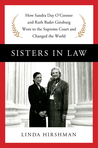
 Sisters in Law: How Sandra Day O'Connor and Ruth Bader Ginsburg Went to the Supreme Court and Changed the World by Linda Hirshman
My rating: 4 of 5 stars
The book provides a very good legal history, particularly the discussions of Ginsburg's early work with the ACLU. There's also a worthwhile discussion and examination of what it means to use recourse to the courts as a mechanism to produce social change. Specifically, understanding what cases to bring and in what order to bring them in order to effectively change the legal standard, and thereby change of the relevant legal precedent in future cases, is interesting for any legal geek to read. It demonstrates the strategy that must exist and plotting the the order of cases to bring, as opposed to just individual strategies to win each particular case.
I think it is evident from the beginning of the book that the author tends to relate, or favor, Ginsburg more than O’Connor. This may be due to a shared legal perspective - Ginsburg was consistently liberal, O’Connor was conservative, but also pragmatic. It could be due to the fact that many of O’Connor’s decisions seemed political; not political in terms of promoting a certain political agenda, but political in preserving precedent and righting certain discriminatory wrongs, but not establishing broad new precedent. Doing so allowed O’Connor to wield more control of the Court’s direction than she may have had otherwise. Understanding this dynamic, which the author does a very good job explaining, provides interesting and insightful information on how the Supreme Court functions and issues decisions.
Except towards the end of the book, the author does a good job of focusing on Ginsburg and O’Connor, and their individual and unique circumstances that led them to the Court. In doing so, we, as readers, are given a fascinating portrait into two of the significant women in the last 40 years, as well as a fresh reminder of how many of our discriminatory ideas and practices against women were still widely prevalent not that long ago.
Near the end of the book, the author leaves some of the focus from O’Connor (understandably, as she left the Court in 2005), but even away from Ginsburg, to take opportunities to discuss and criticize many of the recent Court opinions. In some respects, this makes sense in discussing Ginsburg as the “dissenter” in the most recent years. But in other respects, the author spends a little too much time, I think, attacking certain opinions, particularly those of Justice Kennedy, to the detriment of discussing Ginsburg’s legacy.
That said, it doesn’t detract from an otherwise really enjoyable read, that is packed with information and insight, and shares the story of two remarkable women.
View all my reviews


No comments:
Post a Comment