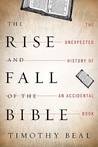
 The Rise and Fall of the Bible: The Unexpected History of an Accidental Book by Timothy Beal
My rating: 3 of 5 stars
Beal's work here is solid - it is well researched, provides relevant details, and is mostly, I think, accessible for most readers.
As the title suggests, this book is about "The Bible." Beal, a Christian, begins his exploration with a discussion of the present and immediate past that is both enlightening in many regards, but also, I would think, disheartening for people who attach some meaning of their faith to the Bible. As Beal notes, there has been a boom in Bible publishing in the last 3 decades, with a multitude of different translations available, and various Bibles that have a plethora of study guides and explanatory material involved (to the point where some of these Bibles devote more words to explanation than to the believed actual "word" of God). What Beal argues in his first section, quite persuasively, is that the Bible has reached a cult or iconic status that has actually suppressed spiritual exploration. Many (if not most) people who have a Bible have not read it, yet they view it as the "authoritative source" for moral and religious behavior. Others, having read it and maintaining the same belief, or led to disbelief due to the inconsistencies and conflicts throughout.
In the second part of the book, Beal discusses how those inconsistencies and conflicts came about. For anyone who has read about the history and development of the Christian religion, and thus by extension, its holy book, Beal does not cover new ground. That said, because his background is one ultimately of faith, his discussion is perhaps more sensitive than other materials may be, and thus may be more accessible for many readers.
In all, I found the argument in the first section to be well stated and even persuasive at times, and the second part to be, though redundant of other materials I have read, to be well-written and thoroughly researched. Ultimately, I enjoyed Beal's conclusion where he suggests that it would be healthier to view the Bible (and more historically accurate) as a library, as opposed to a book. A library is a place of many different sources and voices, to ask questions and research, to engage in exploration. Such a thought does make one wonder how different things would be if this was the view of the Bible throughout history to the present.
View all my reviews


No comments:
Post a Comment